AR from a printed card, no app
An award-winning interiors practice in Singapore whose work is three-dimensional and whose marketing was mostly photographs, printed brochures and flipbooks.
/work/room-on-a-cardCame in new build
- System
- Web AR from a printed card, working prototype
- Ask
- A card that opens the practice's work in 3D
- Region
- Singapore
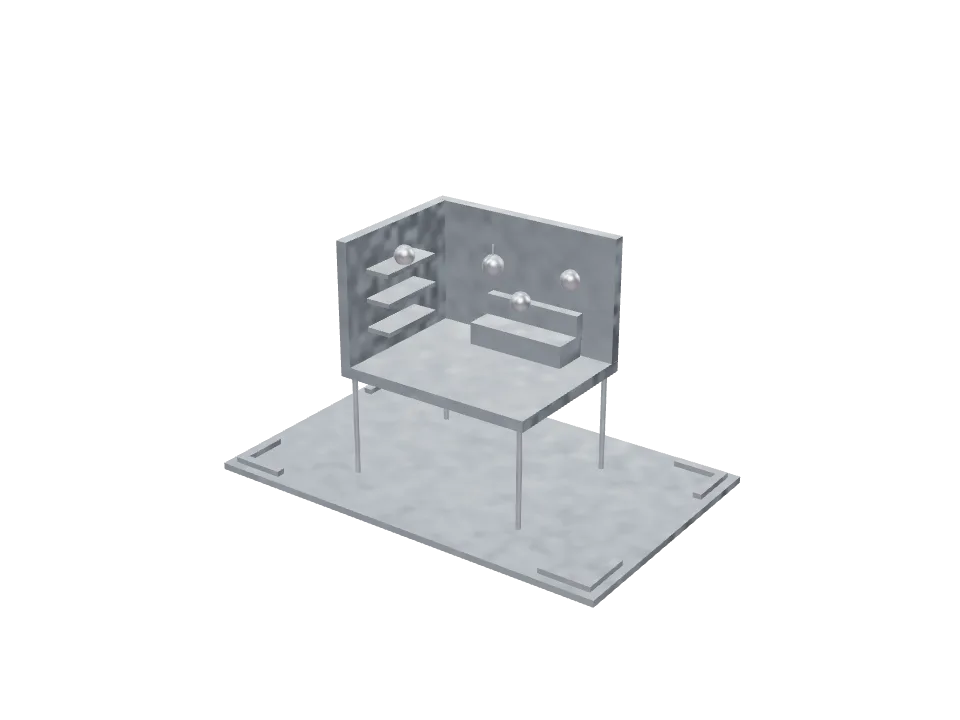
The piece A thin card with four corner brackets and a room rising out of it, four hot studs where the four hotspots sit.
- 2daysidea to working prototype
- 4ways infrom one scan
- No appfrom the camera to the browser
- iPhone and Androideach with its own AR
The ask
Something to hand out at show flats and events that people would keep, more than a business card with a link.
The real problem
Showing a room in 3D usually means an app, and people at an event won't install one.
A paid web AR platform shut down in February 2026, yet the card still had to work on iPhone.
What sits between card and room
- Idle
- Live
- Strain
- Fail
The usual wayScan, then an app store, an install and an account before the room appears.
What we builtScan straight into a browser page, where the phone's own AR places the room.
What we built
A static web page behind the QR code opens a miniature 3D room in the browser. One tap hands it to the phone's own AR, which sets it on a table or floor at scale.
A 360° view puts you inside the room at full size, with four hotspots. In card mode the room rises out of the printed card. Every view carries a link to book a consultation.
How we made it hold
Placement uses the AR built into each phone, so the room holds still while you walk round it. Card mode comes after that steady view.
Backstage The decisions behind the build, and the hardest problem
Decisions
The phone's own AR for placement.
Quick Look on iPhone and Scene Viewer on Android hold the room steady and need no paid SDK.
Image tracking in the browser for card mode.
The room rises from the printed card with nothing installed and it comes after the steady view.
Every library shipped with the page.
It runs from any web host, with no licence and no cost that grows with each scan.
Ruled out
An app.
Every step before the room, from the store to the install to the account, loses people.
A paid web AR platform.
One shut down in February 2026 and its fees would have grown with every scan.
The hardest problem
Making iPhone work in the browser without a paid AR platform. Placement goes through the AR built into the phone. Card mode tracks the printed card directly in the browser, against a target compiled from the card's own artwork.
The difference
- A printed card opens a 3D room from the camera on a recent iPhone or Android.
- It runs from an ordinary web host with no AR licence and no cost per scan.
- Tested on a laptop screen before printing.